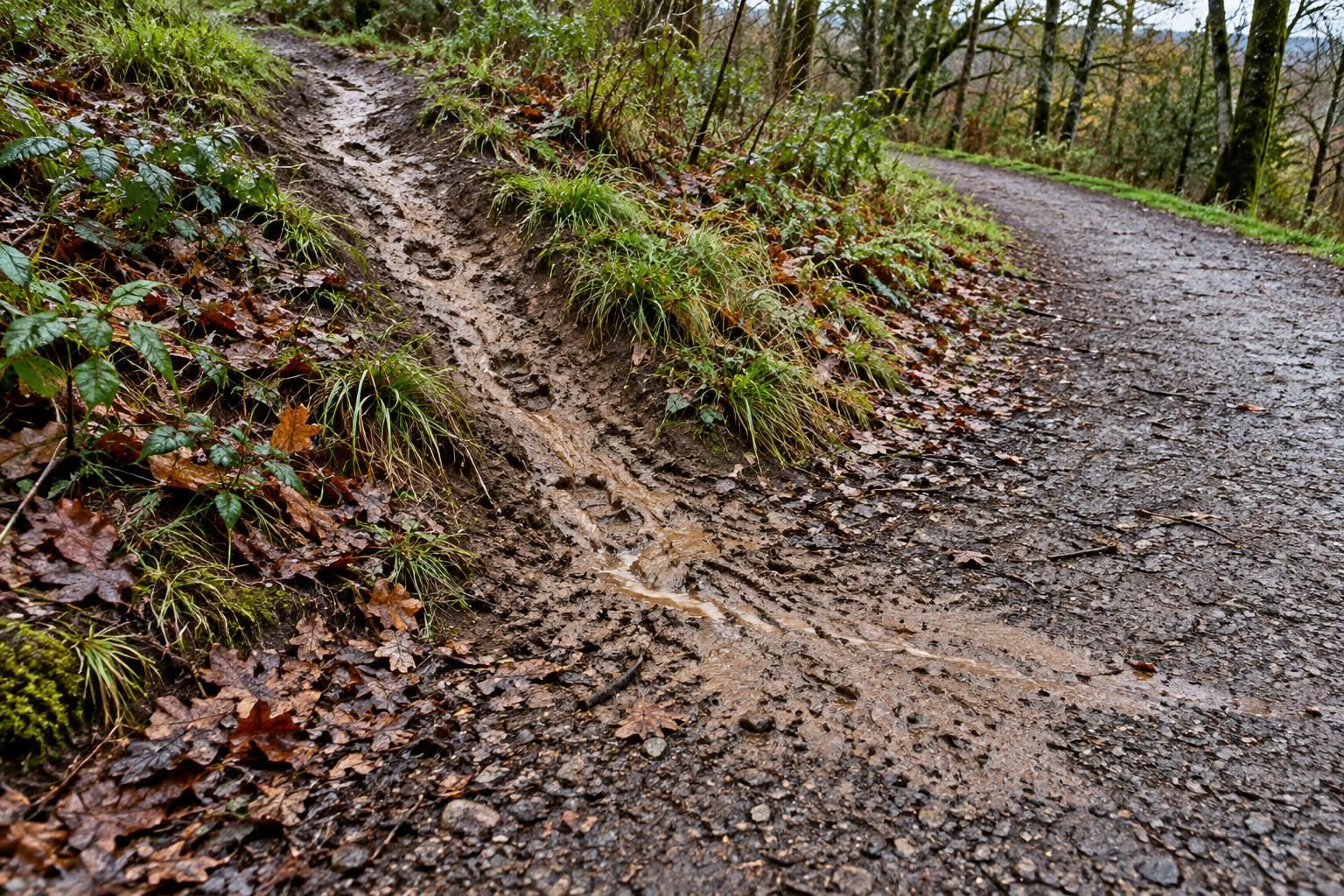
A shortcut across a bend in a footpath can save ten steps. After rain, it may also offer a small lesson in where a hillside goes. The grass is pressed flat, a dark strip holds water, and at the bottom of the strip a fan of fine mud spreads over the path it was meant to avoid. That fan is soil in a new place. It does not tell us how much has left the wider site, or whether every boot print helped move it. To understand the loss, start before the mud begins to run.
The first change is underfoot
Repeated feet bend or break plants and disturb the litter that cushions the ground. They can press soil particles closer together, changing the spaces through which water enters. A narrow unofficial route becomes visible long before it becomes a trench. A study of a “social trail” across a University of Nebraska green space compared samples on and off the worn line. Soil texture and structure appeared similar in the two sets, while the trail samples had significantly higher bulk density and slower measured infiltration. Those measurements support compaction at that one campus path. They do not show that a particular rainstorm removed a measured mass of soil.
Even a shoe's effect on plants is not a simple permanent score. In four vegetation types studied by the U.S. Forest Service, lug-soled boots caused more immediate loss of plant cover than running shoes under experimental trampling. A year later, shoe type no longer made a significant difference to cover loss. The study did not measure sediment leaving a trail; it separates the first visible damage from the longer outcome. Plants may recover, while a route kept in use receives the next round of feet before it does.
Compaction itself is a condition, not the same thing as erosion. A dense tread can admit less water and produce more surface flow. A heel can also loosen a wet clod and push it a few centimetres sideways. Neither event necessarily carries material beyond the path. Rainfall, slope and a connected route downhill have to do more work before the soil becomes an export.
When rain finds a channel
At two ecotourism sites in Costa Rica and Ecuador, Thomas Wallin compared trails with adjacent forest using portable rainfall simulators: 41 tests on trails and 44 off them. Trails generated more runoff and mobilized more sediment in those tests. Their bulk density was higher, but neither bulk density nor penetration resistance reliably predicted infiltration by itself. The path's behaviour came from more than one measured property. This is field evidence from humid tropical soils under simulated rain, not a conversion factor for a temperate shortcut.
A closer look at one Australian hiking trail complicates the tidy chain from compaction to loss. In a 2023 rain-simulation experiment near Armidale, researchers applied intense rain to surfaces that varied in cover, looseness and slope. Bare compacted plots tended to produce more runoff than loose or vegetated plots. Yet the amounts of sediment collected from the different surface groups did not differ significantly in that short test. The main purpose of the paper was to study microplastic movement; its measured runoff and sediment offer a useful caution for ordinary soil as well. Faster or greater flow does not guarantee a detectable increase in sediment yield every time. The storm was simulated at 100 millimetres per hour, and the observation window was short.
Now return to the shortcut. If it descends straight down a slope, water that reaches the bare strip may run along it rather than crossing it and spreading out. Loose grains from footsteps, exposed mineral soil and the fine particles carried in muddy water can collect at a low point. If the shortcut crosses a grassed bank, the break in cover also interrupts the surface that once slowed that water. Whether the particles stop in the next bend, enter a ditch or reach a stream depends on the route beneath them. A brown puddle proves the presence of suspended soil nearby; it does not prove a distant river received it.
The trail can lose ground without exporting it all
There is a way to see more than a single muddy moment. Aleksandra Tomczyk and Marek Ewertowski repeatedly surveyed 12 small trail fields in two protected areas of southern Poland. They compared detailed elevation models between visits, locating where the surface lowered and where it rose. Some fields lost substantial volume over the two-year period; in others, deposition balanced or exceeded removal. The method also showed that a smooth average can hide a boot-scuffed patch beside a little deposit. The numbers belong to those selected fields, but the distinction travels: a change in surface shape can be local redistribution, net removal, or a mixture.
Their observations also connect rough ground to how people walk. A difficult or muddy tread invited bypassing, which widened the affected area. Roots and rock fragments could trap or protect material in some sections. On a gentle shortcut, water may sit and make the route unpleasant; on a steeper one, it may find a channel with enough force to move particles downslope. Neither “steep” nor “muddy” is a complete diagnosis without looking at where water comes from and where it can go.
It might seem that every shortcut should simply be hardened. That decision has its own footprint. In a comparison of trail edges in an Australian blackbutt forest, researchers examined two informal earth routes and formal gravel and paved routes. Vegetation cover and species richness at the edges were broadly similar to control sites, but the gravel and paved routes showed differences in understory plant composition that the earth routes did not. The work concerns vegetation beside existing trails, not a trial of erosion controls. It is a reminder to ask what a proposed repair would disturb as well as what it might protect.
For a walker, the useful evidence is modest and close to the ground: flattened cover at the start of a new line, a hard smooth tread or loose churned soil, rainwater moving along rather than across it, and a deposit where the grade eases. The material in that deposit came from somewhere uphill, though its amount and destination need measurement to know. A shortcut's cost is not contained in the steps it saves. It is written in the route repeated feet create for the next rain, and in whether that rain leaves the soil on the slope, moves it a little, or carries it beyond the path.
A thought worth keeping?